 William Fullerton, Jr. (1854 – August 25, 1888) was an American-born composer and songwriter who carved out a vibrant niche in London's theatrical and musical scene during
the 1880s.
William Fullerton, Jr. (1854 – August 25, 1888) was an American-born composer and songwriter who carved out a vibrant niche in London's theatrical and musical scene during
the 1880s.Partner Percy Anderson
Queer Places:
The Fullerton, 297 Grand St, Newburgh, NY 12550, United States
Columbia University (Ivy League), 116th St and Broadway, New York, NY 10027
Queen Anne's Gate, London SW1H 9BT, United Kingdom
The Well at Well, Hook RG29 1TL
All Saints Churchyard, Croft Ln, Crondall, Farnham GU10 5QF, United Kingdom
William Fullerton, Jr. (1854 – August 25, 1888) was an American-born composer and songwriter who carved out a vibrant niche in London's theatrical and musical scene during
the 1880s.
Born in Newburgh, New York, he was the sensitive, musically inclined only son of the prominent and aggressive American trial lawyer William "Judge" Fullerton.
Growing up, young William showed a wonderful natural affinity for music early in his life. Recognizing this talent, his father sent him abroad to pursue the study of music around 1876 (about twelve years prior to his death). From that time onward, with the exception of short visits home, he lived entirely in Europe. The young musician studied under the best masters in both Germany and England, soon making an enviable name for himself.
In 1875, at age 20, he had been living in Manhattan and briefly enrolled at Columbia University's School of Mines while struggling to find his identity under the shadow of his formidable father. That same year also brought intense public scrutiny to the family when Judge Fullerton became famous nationwide for his masterful, aggressive cross-examination during the sensational Henry Ward Beecher adultery trial.
Relocating to England, Fullerton found the artistic freedom and cultural environment he sought. He settled down and lived openly with Percy Anderson, a talented aristocratic painter who would become one of the leading theatrical costume designers in history. The couple shared beautifully appointed rooms—including quarters in Queen Anne's Gate—which quickly transformed into a vibrant salon and gathering place for actors, musicians, and artists. During this time, Fullerton published a variety of popular compositions. Several of his works were dedicated to members of the British Royal Family and high society, including: "May-be-so!" (1880), dedicated to the Duchess of Westminster. "In a Dream" (1881), a lieder-style piece based on a Heine poem, dedicated to Lady Agneta Montagu. "White Lilies Waltz" (1882), dedicated to Prince Leopold, Duke of Albany. "Tel-el-Kebir", a military march commemorating British rule over Egypt.
Fullerton played a pivotal role in launching the professional careers of two major figures of the Victorian stage: costume designer Percy Anderson and matinee idol baritone Hayden Coffin.
In March 1885, Fullerton achieved his greatest theatrical success with the comic opera The Lady of the Locket (featuring a libretto by Henry Hamilton) at London's Empire Theatre. Running successfully for five months, the costly production was the standout hit of an otherwise dismal theatrical season. It provided Percy Anderson with his very first stage design commission, instantly propelling him into decades of acclaim.
Following their initial triumph, the creative trio began working on a follow-up light opera titled Waldemar: Robber of the Rhine (with a libretto by Maurice Barrymore). However, Fullerton's health began to rapidly fail.
Afflicted by consumption (tuberculosis), Fullerton grew severely ill in the summer of 1888. Percy Anderson spirited him away to the countryside (noted in contemporary dispatches as occurring at Oldham, a suburb of London) hoping to aid his recovery, but Fullerton passed away on Saturday, August 25, 1888, at the age of 34. Apparently Judge Fullerton was completely prostrated at the death of his only child, whom he idolized (according to William's obituary).
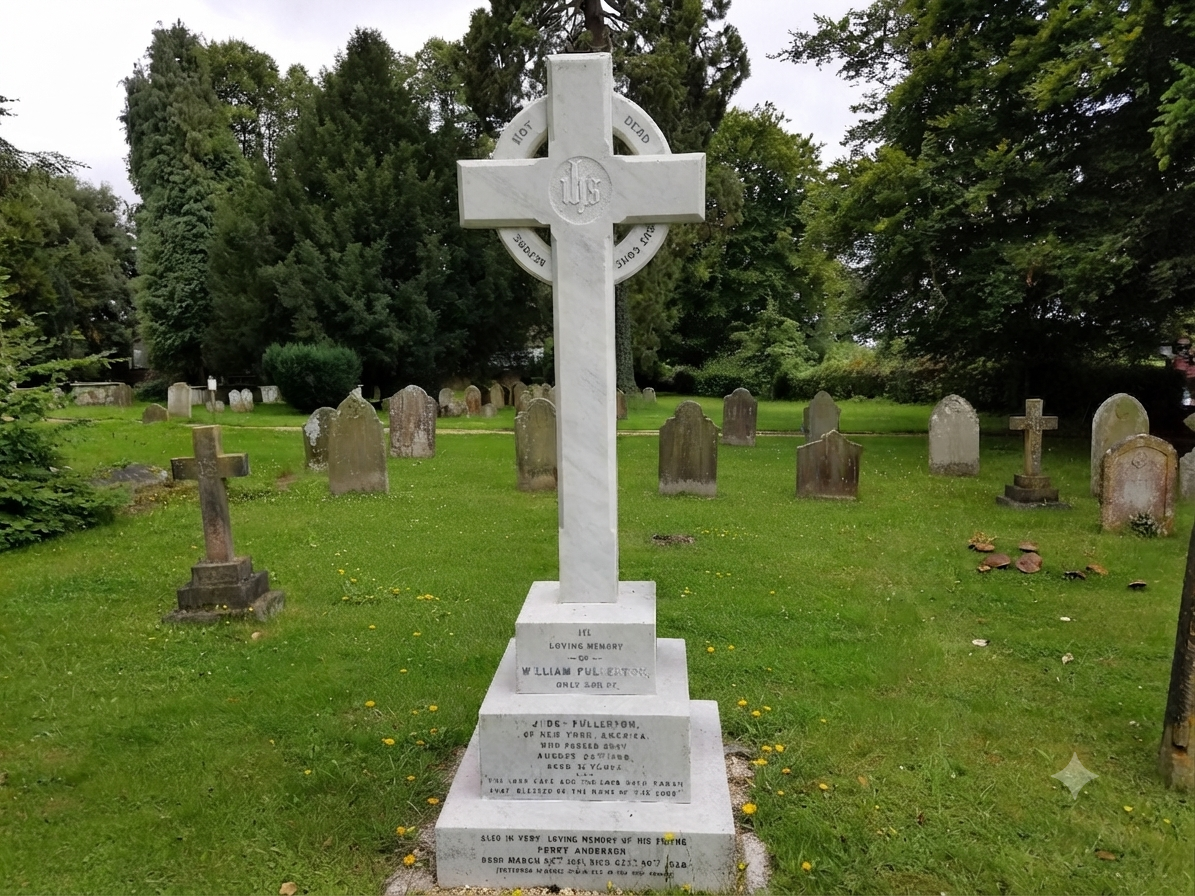
Anderson deeply mourned the loss of his partner, organizing his burial in the churchyard of All Saints' Church in Crondall, Hampshire. A touching memorial in The Times mourned the loss of "our Billy". Decades later, when Percy Anderson died in 1928, he requested to be buried in the exact same Hampshire cemetery, resting alongside the companion of his youth.
Near the cemetery, in the small rural Hampshire village of Well near Hook (RG29 1TL) that is deeply intertwined with local history, there is a monument above an old well in the hamlet where Willie passed away. Although 20th-century replacement signage states it was a gift from William Fullerton to the village, it was most likely constructed by Percy in William's memory.
References:
Support this project
This website is a passion project researched, developed, and funded entirely by me. If you find the content valuable and would like to help support the ongoing research and hosting costs, any contribution is deeply appreciated.
Thank you for keeping this independent resource alive!
My books on Amazon: Elisa Rolle's books